Part 1: The Biological Foundation
The Somatic Anchor: Heavy Reality in a Disconnected World
"I observe dozens of clients daily who attempt to meditate their way out of a sympathetic nervous system response. They sit in high-rise apartments, surrounded by 5G routers, clutching a polished piece of clear quartz, wondering why their heart rate won't drop. The problem is a lack of friction. They lack gravity."
The Physiology of the Float
To understand why Black Tourmaline—specifically in its raw, unpolished Schorl form—is a mandatory tool, we must examine the biological state of what I call 'The Float'. This is sympathetic dominance combined with sensory deprivation. In modern environments, we are subjected to high-frequency cognitive inputs (emails, notifications, hyper-fast media editing) while our physical bodies remain entirely static in ergonomic chairs.
Blood flow retreats from the extremities. Proprioception—the body's ability to sense its location in space—diminishes. When your brain cannot feel your feet, it registers a subconscious falling sensation. It assumes you are in danger, triggering the adrenal glands. You cannot think your way out of this loop. You must introduce a heavy, undeniable physical sensation to act as a haptic interrupt.
The Vagal Brake and Physical Weight
This is where the mineral density of Schorl comes into play. Black Tourmaline is an iron-rich borosilicate. It is physically heavy. A substantial, raw piece of Tourmaline held in the palm forces the brain to allocate processing power to the sensation of weight, temperature, and texture.
Stop using tiny, ten-gram tumbled stones for this specific application. They are aesthetically pleasing but somatically useless for acute regulation. You need a piece that weighs at least half a pound. The weight creates a downward energetic drag. As your hand registers the density, the shoulder drops. As the shoulder drops, the diaphragm has space to expand. This mechanical chain reaction engages the Vagal Brake, signaling to the parasympathetic nervous system that the environment is solid, stable, and safe.
The Ugly Truth: The Mess of Raw Minerals
Let us address a reality check that marketers avoid. Raw Black Tourmaline is messy. Because of its complex crystalline structure and prominent cleavage planes, a true piece of raw Schorl will shed microscopic black dust onto your hands and your desk. It can stain white linen. It feels chalky.
This is a trade-off you must accept. The polished stones are clean, but the tumbling process seals off the natural striations that make the stone so effective at directing energy. The dust, the rough edges, the tactile friction—this is the medicine. You wipe your hands afterward, but you retain the grounded focus. Choose efficacy over convenience.
The Heavy Protocol
- The Baseline: Sit down. Bare feet flat on the floor. If you are on carpet, acknowledge that synthetic fibers disrupt electron exchange, but proceed anyway.
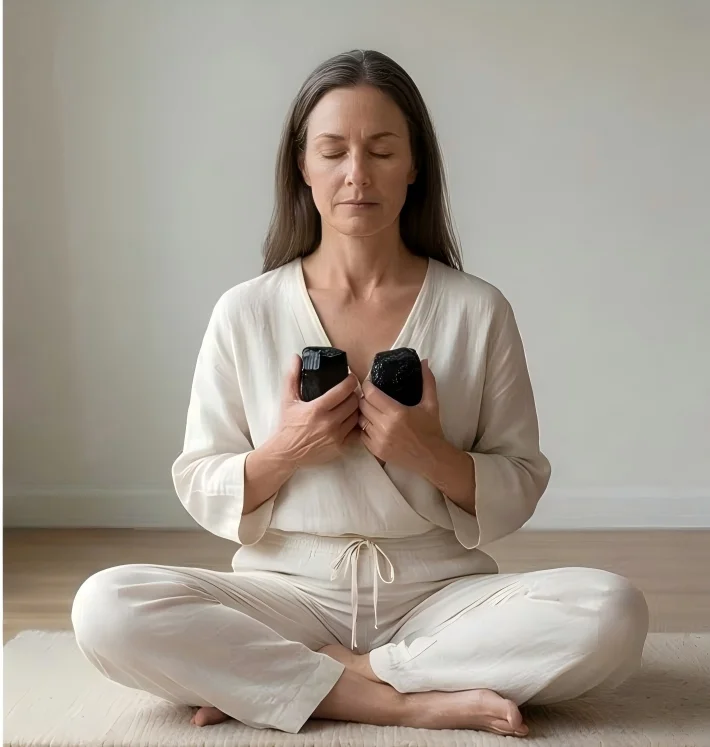
- The Load: Place a heavy, raw Schorl specimen directly on your thighs or hold it in both hands. Close your eyes. Focus entirely on the gravitational pull of the stone.
- The Acknowledgment: Notice the texture. Is it cold? Do the striations run vertically? Your mind will attempt to return to your inbox. Force your cognitive attention back to the physical boundary of the stone.
Part 2: Advanced Interaction
Filtration Over Reflection: The End of Defender's Fatigue
For over two decades, the standard directive given to highly sensitive individuals navigating dense environments was to 'shield.' Practitioners instructed people to visualize impenetrable walls of white light or to wear mirrored stones to bounce negative projections back at the sender. As a veteran in this field, I can tell you definitively: this approach is biologically and energetically exhausting.
Maintaining a rigid, defensive posture requires continuous active expenditure of energy. It results in what I term 'Defender's Fatigue.' Furthermore, walking through the world wearing an energetic mirror often escalates ambient hostility. Black Tourmaline offers a fundamentally different, far more sustainable architecture: Filtration.
The Obsidian Mirror vs. The Tourmaline Sponge
It is crucial to differentiate between Black Obsidian and Black Tourmaline. Obsidian is volcanic glass. It is amorphous, sharp, and highly reflective. It acts as a mirror. If a colleague projects frustration toward you in a meeting, Obsidian bounces it back. This can create a feedback loop of tension in the room.
Black Tourmaline, conversely, is a crystalline structure characterized by deep parallel striations. It does not reflect; it absorbs, channels, and neutralizes. It acts as a heavy-duty carbon filter. When you carry Schorl, you are outsourcing your energetic metabolism. The stone volunteers its dense lattice to process the ambient static so your own nervous system does not have to.
Reality Check: The Cost of Absorption
There is a distinct disadvantage to the sponge method. Sponges get full. I have seen clients carry the same piece of Black Tourmaline in their pocket for six months without clearing it, and then wonder why they feel sluggish, heavy, and irritable. A saturated stone stops filtering and starts radiating the accumulated density back into your bio-field.
If you choose to use Tourmaline as a filter in high-friction environments—such as hospitals, corporate offices, or crowded transit—you are committing to a rigorous maintenance schedule. You cannot be lazy with this tool. We will discuss the clearing protocols later, but understand that this is the trade-off for not having to maintain a constant personal shield.
Strategic Placements
Stop placing stones randomly. The geometry of your space dictates the efficacy of the tool.
- The Line of Sight Break: In an open-plan office, place a substantial piece of Tourmaline directly between your keyboard and your monitor. This specifically addresses the subtle, continuous stress generated by screen glare and digital demands.
- The Left-Side Guard: The left side of the body is traditionally associated with the reception of external stimuli. Keeping a small, tumbled piece (this is the one scenario where tumbled is acceptable to protect fabric) in your left pocket acts as a preliminary sorting mechanism before energy enters your core awareness.
Part 3: Psychological Integration
Integration: The Cold Container for Deep Processing
The modern wellness industry has a dangerous obsession with immediate transcendence. We are sold the idea that focusing on 'light' will simply erase the deep, often uncomfortable, physiological imprints of our past experiences. This is a severe misunderstanding of human psychology. You cannot bypass the shadow. When individuals begin deep integration work, the body often responds with intense sympathetic arousal. Panic sets in.
The Destabilization of Release
When suppressed memories or long-held physical tensions begin to surface during therapy, breathwork, or intense introspection, the sensation can be terrifying. The internal structure feels as though it is collapsing. During these moments, high-vibration stones like Amethyst or Moldavite are actively detrimental. They pull energy upward, exacerbating the feeling of leaving the body.
Black Tourmaline serves as the 'Seismic Damper.' Think of the massive steel pendulums installed inside skyscrapers to counteract earthquake tremors. Schorl provides a dense, unshakeable frequency that acts as a container. It communicates a singular, vital message to the nervous system: "We are not floating away. The ground is still here. You are anchored while you process this."
The Reality of the Void
I must offer a reality check regarding the color and texture of this work. Black Tourmaline is not a warm, comforting stone. It does not feel like a hug, the way Rose Quartz might. It is cold. It represents the mineral earth, the void, the dirt to which all biological matter eventually returns.
This lack of warmth is exactly why it is effective. It is completely neutral. It does not judge the grief, anger, or shame you are processing. It simply accepts the discharge without altering its own structure. It is the compost bin for psychic debris.
The Downward Flush Protocol
This protocol is designed for moments of acute psychological overwhelm.
- Positioning: Lie flat on a hard surface. Avoid soft mattresses; you need the physical resistance of the floor against your spine.
- Placement: Place a raw Black Tourmaline directly on the lower abdomen, just below the navel.
- The Mechanism: As you breathe, focus on the sensation of the stone's weight pressing down. Visualize the chaotic emotional energy—often felt as a tight chest or a buzzing head—being drawn downward by the gravitational pull of the stone, draining out through the soles of your feet into the floorboards.
- The Trade-off: This process can leave you feeling extremely tired and physically cold. You are moving a significant amount of metabolic energy. Have a blanket and water nearby. Do not attempt high-focus cognitive tasks immediately after.
Part 4: Structural Limitations
Saturation Limits, Structural Failure, and the Nightmare Effect
Working extensively with Black Tourmaline means confronting its physical limitations. Beginners often panic when a beloved stone exhibits strange behavior. I have fielded frantic emails from individuals believing they are under psychic attack because their Tourmaline split in half on their bedside table. Let us strip away the superstition and look at the physical and energetic mechanics.
Phenomenon 1: Structural Cleavage and "Explosions"
Raw Schorl is brittle. It possesses a Mohs hardness of 7, but it has complex, uneven fracture patterns and internal stress points created during its formation deep within pegmatites. It is highly susceptible to thermal shock. If you leave a black stone in direct sunlight on a windowsill, it absorbs massive amounts of heat. If a cool draft then hits it, the sudden temperature differential can cause it to crack loudly.
From an energetic perspective, we refer to this as reaching the Saturation Limit. When a stone has absorbed an overwhelming amount of dense frequency and lacks the capacity to process it, it sacrifices its structural integrity. It shatters to dissipate the load rapidly.
The Veteran Advice: Do not attempt to superglue it back together. The internal lattice is compromised. You have extracted the maximum value from that specific piece. Return the shards to the soil outside and procure a new specimen. Do not romanticize a broken tool.
Phenomenon 2: The Detox Nightmare
A widespread recommendation is to place Black Tourmaline under your pillow to support sleep rhythms. For a significant percentage of individuals, this results in vivid, exhausting, and terrifying night terrors during the first week of use.
This is not the stone "attacking" you. This is a forced somatic detox. If your waking hours are spent avoiding low-frequency emotions, placing a massive grounding anchor near your head forces that suppressed material to cycle through your subconscious while your ego defenses are down. It is pulling the debris down the drain, and you are witnessing the process.
The Correction: If you experience this, you are titrating the exposure incorrectly. Remove the stone from the bed immediately. Place it on the floor, in the furthest corner of the room. Over the course of three weeks, slowly move it closer to the bed. Respect the pressure it exerts on the psyche.
Phenomenon 3: Lethargy Overdose
Can you be too grounded? Absolutely. Individuals who wear heavy Tourmaline jewelry twenty-four hours a day often report feeling sluggish, apathetic, and physically heavy-limbed. You have pulled your frequency down so far that you lack the upward momentum required for creativity and action. Tourmaline is heavy medicine. Use it when you are spinning out of control. When you are stable, take it off and allow your natural buoyancy to return.