Structural Mineralogy and the Curatorial Framework of Schorl
In the sophisticated landscape of high-end mineral acquisition, the paradigm has shifted away from viewing geological specimens as mere ornaments or metaphysical artifacts.
Professionals involved in the sourcing and authentication of museum-grade materials now prioritize raw, unadulterated physical reality over aesthetic manipulation. At the forefront of this movement is Black Tourmaline, scientifically classified as Schorl. Contemporary collectors seek fragments of violent geological history rather than artificially polished spheres.
These unyielding, light-absorbing blocks of pegmatite provide a profound sense of spatial tension within a curated environment. This comprehensive overview serves as a technical deconstruction of Schorl, providing the analytical frameworks required to navigate a market often saturated with engineered imitations.
Precise Positioning and Technical Metrics
Understanding the valuation of raw Black Tourmaline requires a departure from traditional gemstone evaluation. In this sector, the stone is scrutinized as a structural artifact rather than a faceted jewel.
The Curatorial Shift Toward Zero-Intervention Minerals
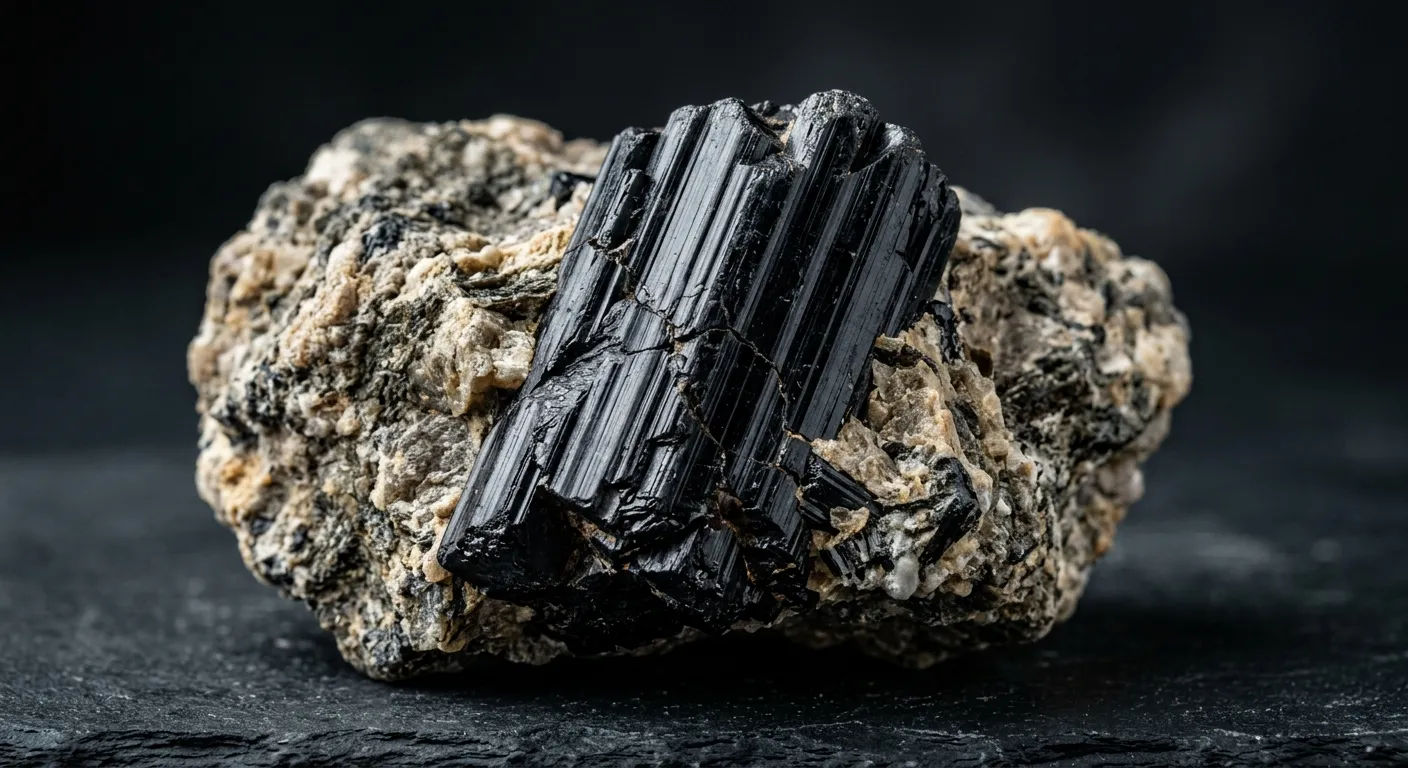
Commercial polishing often erases the geological narrative of a specimen. When a lapidary wheel modifies a stone, the historical record preserved in its surface is permanently lost. High-fidelity Schorl specimens are valued for their brutalist naturalism, representing a zero-intervention aesthetic.
Within this framework, jagged contact points and embedded host rock are considered essential assets. These specimens function as heavy physical anchors, providing extreme material contrast in minimalist architectural settings.
The Baseline of Authenticity and Geological Ecosystems
Evaluation of a specimen must consider the holistic geological ecosystem. An isolated shard lacks curatorial weight; true value is found in the spatial relationship between the tourmaline and its host matrix.
The presence of quartz, mica, or albite serves as the uncompromising natural fingerprint of the crystal, establishing its provenance and academic significance.
The Precision of Striation Fidelity
Authenticity is frequently determined by the presence of sharp clean well-defined vertical striations. These features must not appear soft or artificially smoothed. Instead, they function as a structural barcode that dictates the interaction between the mineral surface and ambient light.
Evaluation of the Luster Index
A high-quality specimen remains completely opaque with a vitreous lustre. With a refractive index typically ranging from 1.614 to 1.666, the surface should reflect light sharply. Any indication of a dull, waxy, or greasy texture often suggests inferior quality or synthetic interference.
Analysis of Density and Specific Gravity
Authentic Schorl is characterized by its high iron content, resulting in a specific gravity between 3.15 and 3.25. The specimen must feel significantly denser than common imitations, providing a tactile confirmation of its mineralogical composition.
The Rarity of Termination Integrity
The value of a crystal increases exponentially when it retains intact hemispherical or pyramidal terminations. Specimens that preserve these natural geometric caps are rare, as many are damaged during tectonic shifts or industrial mining processes.
Assessment of Matrix Stability
Structural integrity extends to the host rock. A matrix that is crumbly or heavily oxidized compromises the long-term viability of the specimen. Curators prioritize stable matrices that can withstand the stresses of display and environmental changes.
Structural Anatomy and Comparative Analysis
Mastery of mineral procurement requires an understanding of the microscopic architecture that governs macroscopic characteristics.
Decoding the Complex Trigonal Crystal System
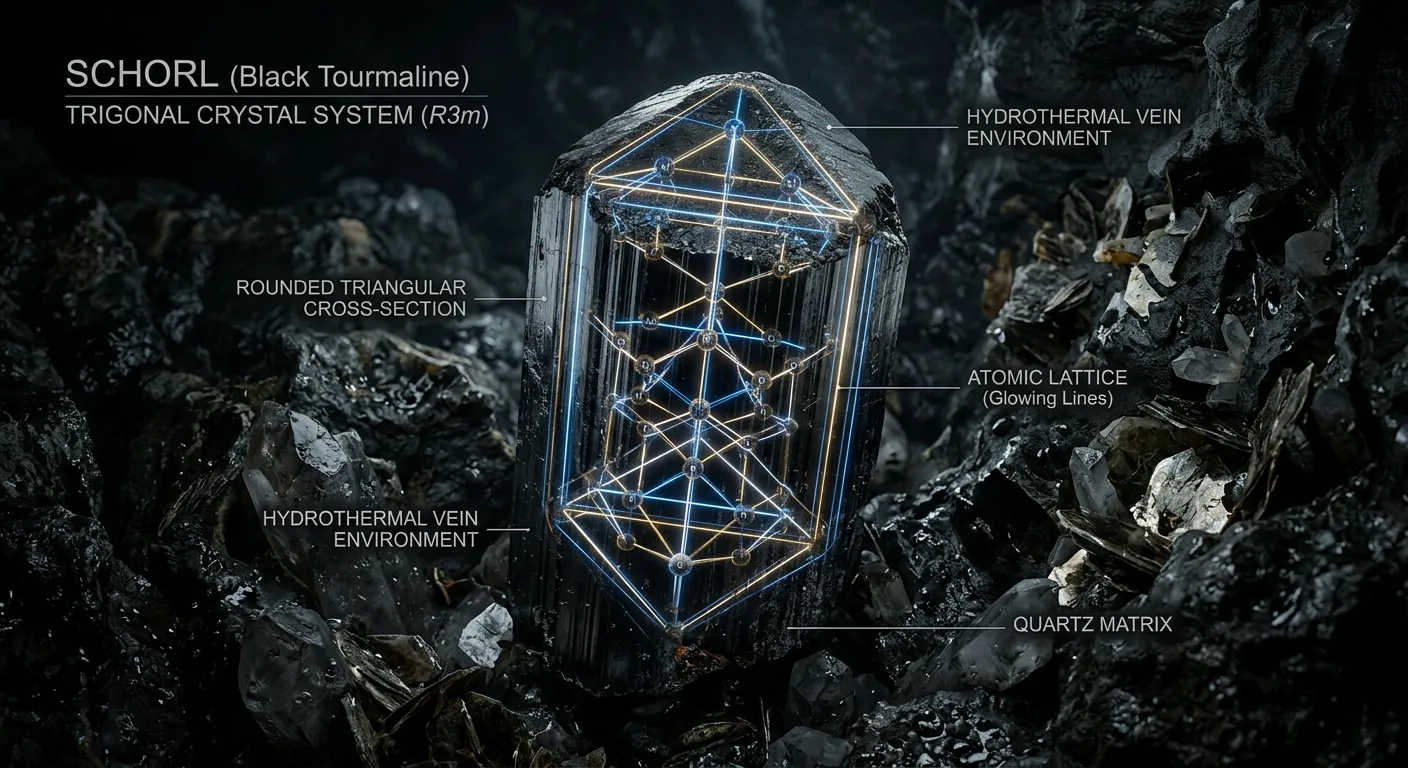
The primary diagnostic feature of Schorl is its complex trigonal crystal system. Observation from a vertical perspective reveals a heavily rounded triangular cross-section. This geometry results from rapid, high-pressure growth within hydrothermal veins.
The resulting elongated trigonal prisms often appear to thrust aggressively from the host rock, creating a striking visual presence.
Mechanics of Terminations and Matrix Fusions
Senior buyers prioritize "floater" crystals, which develop while suspended in pocket clay, thereby avoiding a fused attachment to the rigid feldspar or quartz host rock. While these specimens often exhibit complex dual terminations, they are remarkably fragile.
Finding an intact raw log with clearly defined striations and dual terminations represents a significant statistical anomaly in nature.
Comparative Analysis of Schorl and Obsidian
Distinguishing Schorl from Obsidian is a fundamental skill in mineralogy. Obsidian, a volcanic glass, lacks a crystalline structure and is characterized by the smooth, curved, conchoidal fracture of Obsidian.
Furthermore, Obsidian is lighter, with a specific gravity of approximately 2.4. In contrast, Schorl is defined by parallel striations running up the sides and a significantly higher density.
Natural Matrix Versus Engineered Composites
A natural matrix displays an organic intergrowth of minerals, whereas an engineered composite is often a surgical assembly of crystals secured with epoxy.
A natural specimen will produce a sharp resonance when tested with a steel probe, while a composite will yield a dull, dampened sound.
Qualitative Observation of Piezoelectric Dynamics
Schorl exhibits documented piezoelectric and pyroelectric properties, generating an electrical charge under mechanical stress or thermal fluctuations.
While some communities attribute subjective qualities to this phenomenon, the physical reality of these reactive properties adds a layer of historical context to the specimen, aligning it with the scientific fascinations of the 18th century.
Risk Mitigation and Forensic Verification
The secondary mineral market contains numerous examples of fabricated perfection and forged provenance. Specimens that appear unnaturally clean often warrant closer scrutiny for industrial assembly.
Exposing Synthetic Enhancements and Coatings
Dealers may use mineral oils or polymer coatings to mask fractures and simulate a vitreous luster. While these treatments may appear effective under gallery lighting, a 10x macro loupe typically reveals synthetic pooling in micro-crevices.
Authentic tourmaline maintains a sharp, jagged edge that synthetic coatings tend to soften.
The Erongo Floater Case Study
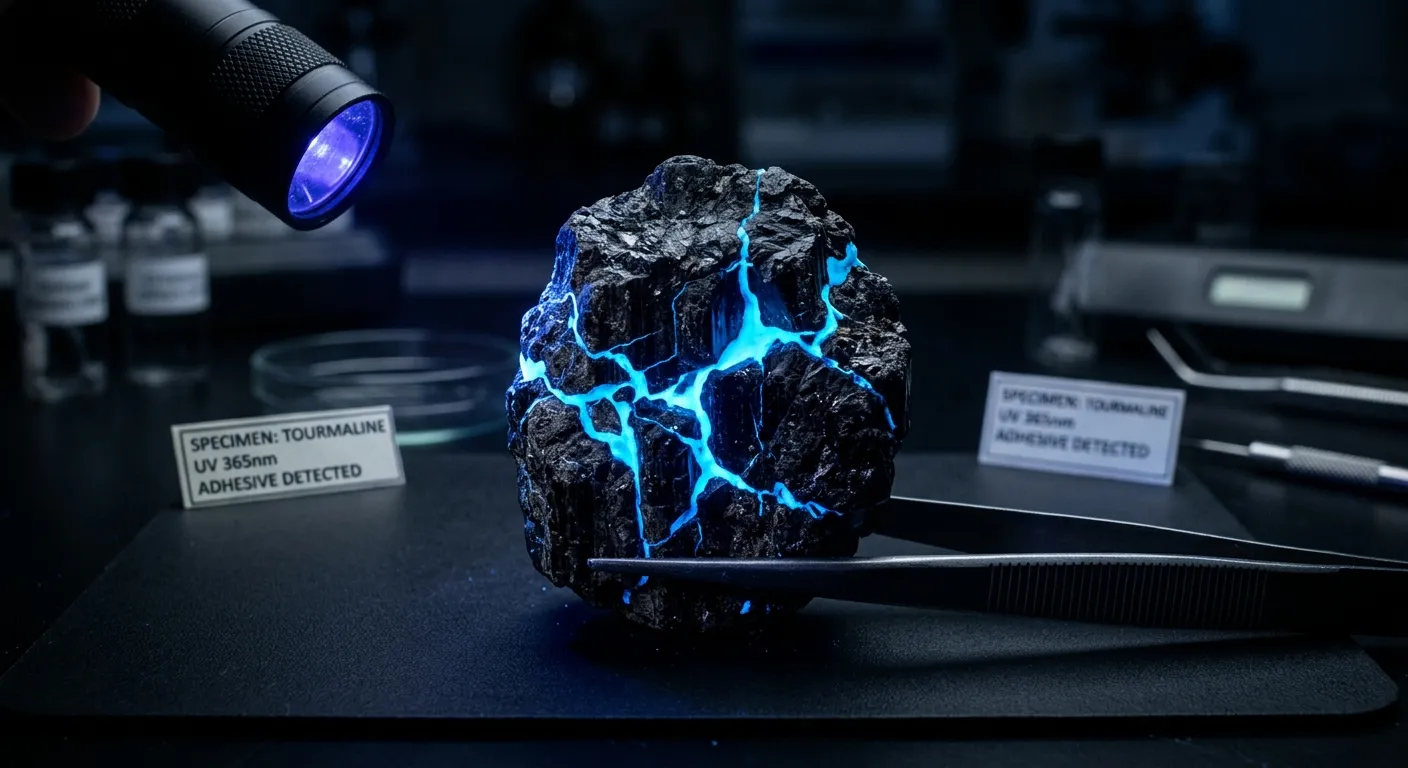
Sophisticated forgeries can deceive even experienced buyers. In one instance involving a large Schorl wand from the Erongo Mountains, the specimen appeared to be naturally embedded in cleavelandite. However, a physical audit revealed that the specific gravity was inconsistent with the volume.
UV fluorescence testing at 365nm exposed unnatural blue light along the seams, indicating the use of industrial adhesives to anchor a mid-grade crystal into a fabricated base.
Advanced Forensic Protocols
Curators utilize intensive UV audits to identify repairs where fractured terminations have been reattached.
Additionally, solvent testing with acetone is a standard procedure; if the luster of the stone diminishes or a solvent odor is detected, the specimen has likely been subjected to heavy chemical doctoring.
Verification of Historical Provenance
The reliability of provenance documentation is often limited by the quality of historical record-keeping. Verifying a chain of custody frequently involves cross-referencing microscopic striation patterns with historical visual records or photographs.
Authentic provenance is built upon the physical anomalies of the stone rather than potentially forged paper trails.
Spatial Curation and Value Assessment
The presentation of heavy, structurally complex minerals requires careful environmental planning.
High-Tension Architectural Anchors
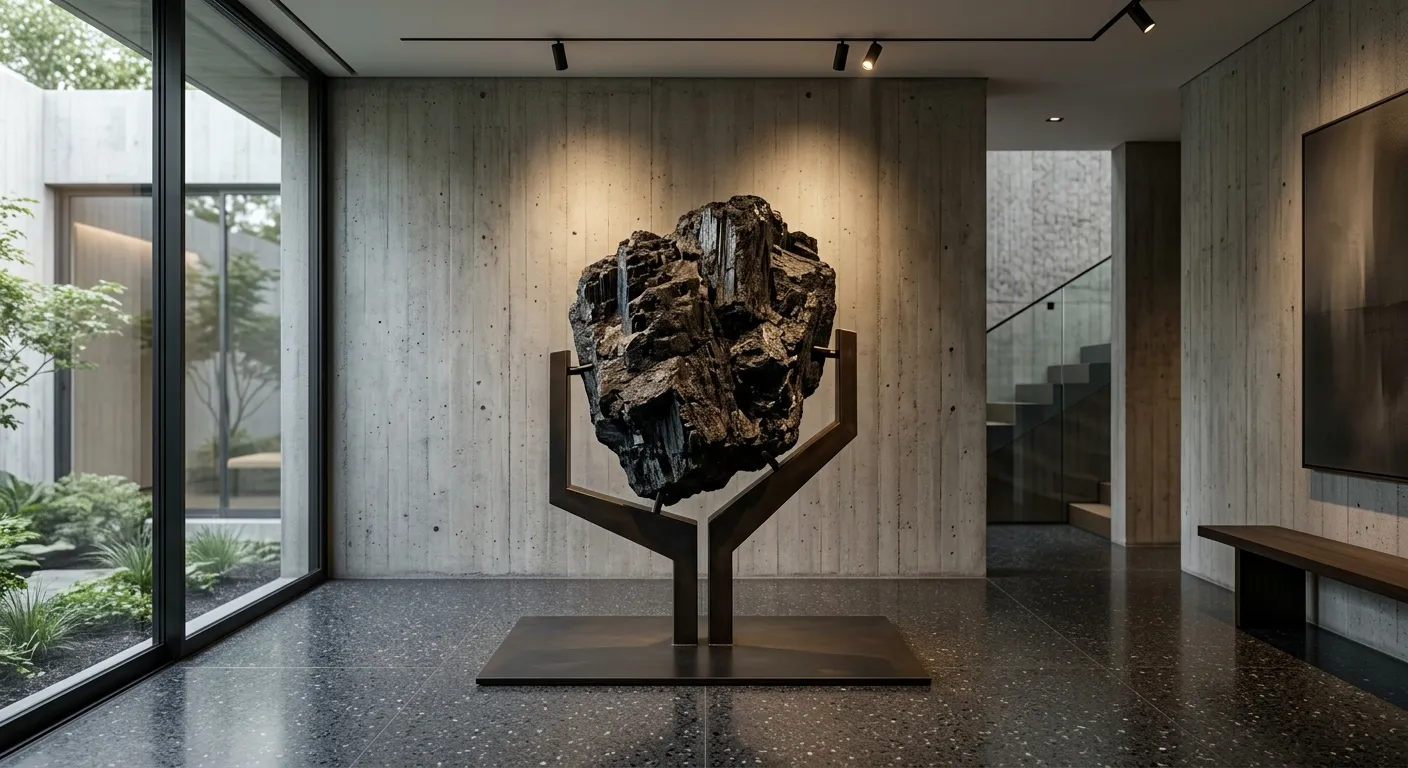
Large matrix specimens, often weighing between 20 and 40 pounds, serve as powerful focal points in minimalist spaces. However, these pieces present a structural weakness under point-load stress when placed on porous surfaces like cement. Custom steel armatures are often required for support.
Furthermore, lighting must be restricted to low-heat LEDs to prevent rapid differential expansion between the dark tourmaline and the lighter quartz, which can lead to catastrophic fracturing.
Personal Ergonomic Dioramas
Medium-sized clusters are often selected for executive environments where tactile engagement is possible. An intact raw log with clearly defined striations provides a grounding physical weight that many find beneficial in high-stress settings.
Aesthetically, these rigid, dark forms provide a stable contrast to the organic shapes of indoor botanicals.
Institutional and Vaulted Archives
The highest tier of curation involves multi-terminated clusters from Namibia or specimens featuring schorl with aquamarine or feldspar. At this level, value is determined by scarcity and structural symmetry.
These specimens are treated as irreplaceable heritage assets, requiring archival mounting and climate-controlled environments.
The Value-to-Cost Ratio Framework
The valuation of Black Tourmaline follows a strict hierarchy:
At the base level, heavily fractured material is sold by weight, typically utilized for landscaping or bulk industrial purposes.
Valuation shifts toward aesthetic integrity when a specimen exhibits sharp striations and a vitreous luster. At this stage, the visual impact of the crystal on its matrix dictates the price.
The highest valuations are reserved for specimens with intact terminations and rare mineral associations. Buyers pay a premium for the statistical rarity of a crystal that has survived tectonic pressures and extraction processes without damage.
Acquiring high-fidelity Black Tourmaline requires a commitment to uncompromising standards. By prioritizing the jagged, heavily striated reality of the Earth's crust over manufactured perfection, curators can ensure the authenticity and long-term value of their collections.
Academic References
Mindat.org (2024)
Crystallography: The Trigonal System
Mindat.org
Britannica (2023)
Trigonal system | Definition & Facts
Britannica
ScienceDirect (2021)
Quartz chemistry of granitic pegmatites: Implications for classification, genesis and exploration
Chemical Geology
GeoscienceWorld (2018)
Mineralogy and Geochemistry of the Erongo Sub-Volcanic Granite-Miarolitic-Pegmatite Complex, Erongo, Namibia
The Canadian Mineralogist